
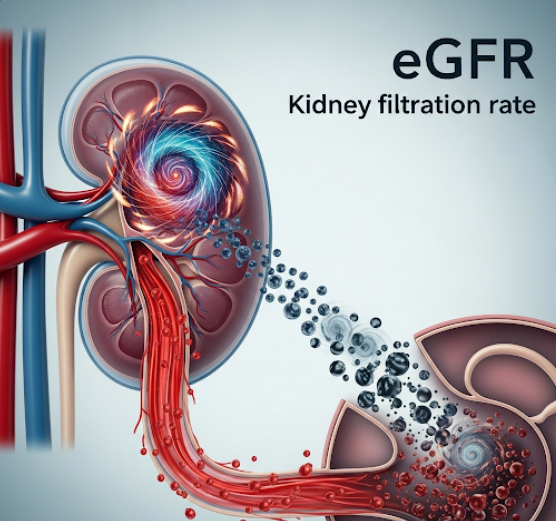
Overview of Estimated Glomerular Filtration Rate (eGFR) Kidney Test
The Estimated Glomerular Filtration Rate (eGFR) is a crucial calculation assessing your kidneys' filtering efficiency. It's not a direct measurement but a value derived from a formula using your blood creatinine level, along with your age and sex. The GFR represents how much blood your kidneys' tiny filters (glomeruli) clean per minute. A higher eGFR signifies healthy kidney function, while a lower eGFR suggests impaired filtering, indicating potential kidney disease. This test is considered the best overall measure of kidney function and is fundamental for diagnosing and staging chronic kidney disease (CKD).
Why it's done
An eGFR test is primarily performed to screen for and diagnose kidney disease, especially in individuals at high risk due to conditions like diabetes or high blood pressure. It helps confirm kidney dysfunction when symptoms arise. For those already diagnosed with CKD, eGFR is vital for monitoring disease progression and assessing treatment effectiveness. It also guides safe medication dosage adjustments, as many drugs are cleared by the kidneys, preventing toxicity. Furthermore, eGFR is sometimes evaluated before specific medical procedures or surgeries to ensure adequate kidney function. Its widespread use makes it a cornerstone in kidney health management.
How should I prepare for the eGFR Kidney Test?
Preparing for an eGFR test is generally simple, as it mostly involves a standard blood draw for creatinine. Fasting is usually not required unless other tests ordered concurrently demand it. Always confirm specific instructions with your doctor or the lab. Crucially, inform your healthcare provider about all medications and supplements you're taking. High doses of biotin (Vitamin B7) can interfere with creatinine measurements, so you might be advised to stop it for a few days before the test. Avoiding strenuous exercise or excessive meat intake shortly before the test is also recommended to ensure the most accurate results, as these can temporarily influence creatinine levels.
What does the equipment look like?
The eGFR itself is a calculated value, not directly measured by equipment. However, the data for its calculation, mainly blood creatinine, comes from standard lab tools. This includes blood draw equipment: a sterile needle, syringe or vacutainer, and specific blood collection tubes. Once your blood sample reaches the lab, advanced automated chemistry analyzers are used to precisely measure creatinine levels in your serum. These large, high-precision machines perform chemical reactions and detect changes to quantify substances. Finally, the measured creatinine value, along with your age and sex, is fed into computer systems or software that apply the eGFR formula to generate your result.
How does the procedure work?
The eGFR procedure begins with a routine blood draw from your arm to measure your blood creatinine level. After collection, the blood sample is processed in a laboratory to separate the serum. Automated chemistry analyzers then precisely measure the creatinine concentration. The core of the eGFR test is a mathematical calculation. This formula integrates your measured creatinine level with personal factors like your age and sex. Common formulas, such as the CKD-EPI equation, estimate the rate in milliliters per minute per 1.73 square meters (mL/min/1.73 m²), indicating the volume of blood your kidneys filter per minute, normalized to a standard body surface area.
How is the procedure performed?
An eGFR test is not a direct procedure but a calculation from a blood sample. The procedure you undergo is a standard venipuncture. You'll be comfortably seated, and a healthcare professional (phlebotomist or nurse) will select a vein, usually in your arm. They'll clean the area with an antiseptic wipe, and a tourniquet might be applied. A sterile needle is then gently inserted, and a small blood sample is collected into tubes. After removing the needle, pressure is applied to the site. The entire process is quick, typically lasting only a few minutes.
What will I experience during and after the procedure?
During the blood draw for the creatinine test (for eGFR), you'll feel a brief, sharp prick or sting as the needle enters your arm. Some mild pressure or discomfort might occur as blood is collected. The entire process is very quick, usually taking just a couple of minutes. After the needle is removed, pressure will be applied to the site to prevent bruising. You might experience minor soreness, tenderness, or a small bruise in your arm, which is normal and typically resolves within a day or two. You can usually resume your normal activities and diet immediately after, as no special post-procedure care is required.
Who interprets the results and how do I get them?
Your blood sample for creatinine is analyzed by lab technologists, and your eGFR is calculated by the lab's computer system. A detailed report with your eGFR and creatinine levels is then sent to your healthcare provider (e.g., GP or nephrologist). Your doctor, trained to interpret these values, will review your eGFR against normal ranges and explain what it means for your kidney health, including the stage of any detected CKD. They will discuss the findings with you and recommend necessary follow-up actions, such as lifestyle changes, medication adjustments, or further tests.
Benefits
The eGFR test offers significant benefits as the most effective measure of overall kidney function. It allows for early detection of chronic kidney disease (CKD), even when creatinine levels appear normal, enabling timely intervention. eGFR provides a standardized method for staging CKD, guiding consistent treatment and prognosis globally. It's a non-invasive, accessible test based on a simple blood draw. Crucially, eGFR helps in safely adjusting medication dosages for drugs cleared by the kidneys, preventing toxicity. It also allows for effective monitoring of disease progression and treatment response, ultimately improving patient outcomes.
Risks
Since eGFR is a calculation based on a routine blood test (creatinine), the associated risks are minimal and solely related to the blood draw itself. The most common minor risks include slight pain, soreness, or tenderness at the puncture site. Minor bruising is also possible and typically resolves within a few days. Some individuals might experience dizziness or lightheadedness during or immediately after the blood draw, especially if sensitive to needles. Very rarely, there's a small risk of infection if sterile techniques aren't followed, or excessive bleeding, particularly for those on blood-thinning medications. These complications are uncommon and generally mild.
What are the limitations of an eGFR Test?
While valuable, the eGFR test has limitations. It's an estimation, not a direct measurement, and its accuracy can be affected by factors influencing creatinine, such as extreme muscle mass, diet, hydration, and certain medications. It's less reliable when kidney function changes rapidly, as creatinine levels may not have stabilized. Historically, formulas included race, which is now being phased out due to equity concerns. A low eGFR indicates dysfunction but doesn't identify the specific cause of kidney disease. Also, "normal" eGFR doesn't always reflect absence of early kidney damage, and symptoms don't always align perfectly with eGFR values.